
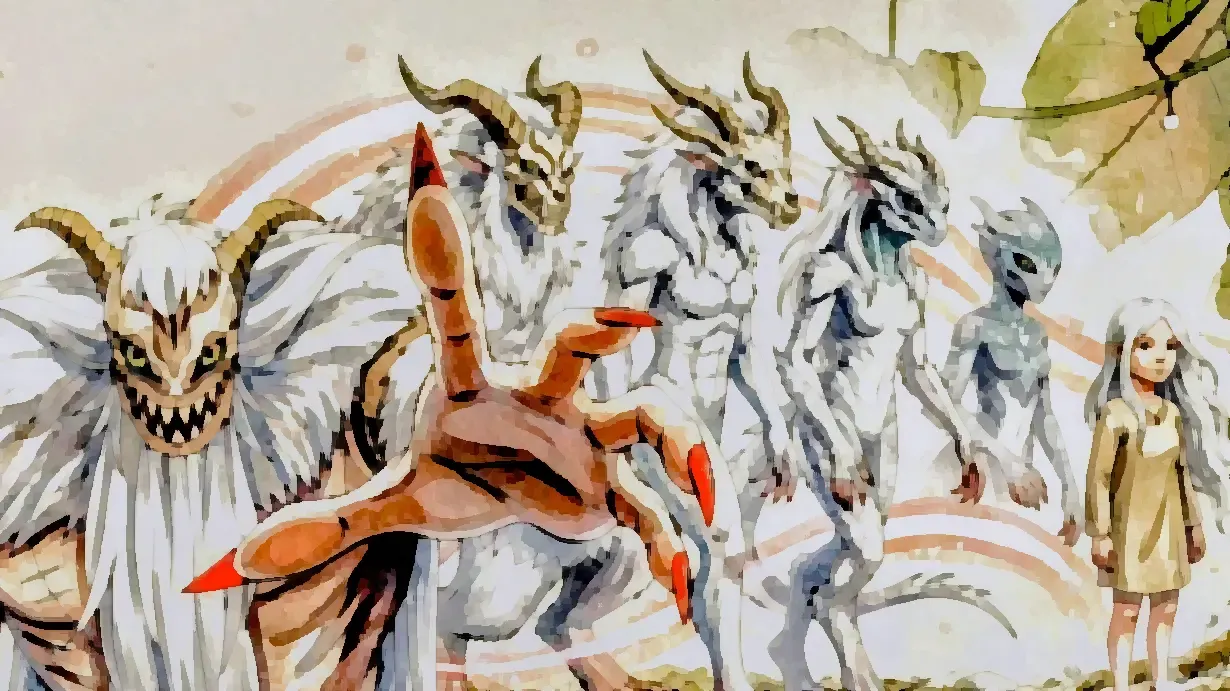
Selective Pressure
In the beginning, the crags of Newfoundland belonged to the titans. They were bloodthirsty behemoths, mountains of matted fur and malice that hunted humans with impunity. But as the settlers arrived with gunpowder and steel, the balance of power shifted. Bounties were weighed in silver, and the largest, most aggressive devils were the easiest to track. Their roaring conquests became their death knells. The cull was absolute, and soon, the monsters of old were nothing but pelts on tavern walls. Yet, life finds a way through the cracks. Only the small, the stealthy, and the strange survived. Creatures hunched and hairless, resembling macaques, scurried silently up the pines, overlooked by hunters who sought bigger prizes.
These smaller variants hid on the periphery of the encroaching human settlements, scavenging and hunting the weak. But humanity’s gaze sharpened, and the towns continued to spread. To survive, the devils underwent a radical, unconscious shift. Those whose faces lacked snouts, whose gait was upright, lived just long enough to pass on their genes. Soon, they walked like men, infiltrating the dark alleys and barns of the waking cities.
But they had no voices. It didn’t take long for the authorities to notice the silent stalkers among them. Broadsheets were nailed to church doors across the territory: Beware the Silent Strangers. If a wanderer cannot speak, they are a devil. Strike them down. To be caught mute became a death sentence. Pitchforks and rifles rooted out the silent mimics in the night, forcing the crucible of survival to demand a new adaptation.
The vocal cords of the devils mutated, stretching and warping to mimic the sounds of their predators. They did not understand the language; they only understood cause and effect. They became biological parrots, baiting traps with human empathy. A militiaman cornering a desperate, starving vagrant in an alleyway would freeze at the sudden, chilling shriek of, “Mommy, I am scared!” coming from a grown man’s throat. “I have a son and daughter, please spare me,” the creatures would beg, their inflection perfectly matching a terrified victim. And when the human lowered their gun in confusion, the devil’s jaw would unhinge. They didn’t want mercy. They wanted blood.
Eventually, humanity learned to see through the psychological camouflage, and the slaughter resumed. But a new pressure emerged, born not from fear, but from the dark, eccentric arrogance of mankind. Wealthy, twisted individuals sought to capture these mimics, keeping them as parlor curiosities. Through generations of forced captivity, a strange, rapid selective breeding took hold. The aggression was systematically bred out; a fawning submission was bred in. An aristocrat could toss a piece of cooked lamb to a creature resting on his rug—one that looked exactly like a beautiful young maid—and boast to his horrified guests how tame she was. The pet devils wouldn’t touch human flesh if starved. Their intelligence, however, was alien—hollow and eager to please, like a hound trapped in a human body.
A century later, the line between wild and domestic had blurred into nothingness. Escaped pets and interbreeding meant that the devils now looked and acted virtually identical to humans. It was a perfect case of Vavilovian mimicry—weeds that had evolved to look exactly like the wheat they grew among, accidentally domesticated by the very farmers trying to pull them. They integrated into society, their minds shifting and adapting to a world of commerce and conversation rather than blood and survival.
The coffee shop in St. John’s was quiet, the glass pane rattling gently against the winter wind. Marcus stirred his coffee, refusing to look directly at the man sitting across from him.
“I know what you are,” Marcus said quietly, his voice tight. “I know the history. You look like me, you talk like me, but I know your true nature. Deep down, you’re the beast on the crag.”
Elias, a devil separated by thousands of generations from his monstrous ancestors, took a slow sip of his latte. His eyes, perfectly human, crinkled in genuine amusement.
“My true nature?” Elias smiled gently. “Marcus, my wild counterparts have been extinct for two hundred years. Even if I saw one, I wouldn’t recognize it. I don’t crave blood. I crave a good dental plan and a warm fire.”
Marcus scowled, gripping his spoon. “It’s a trick. An evolutionary lie.”
“It was an evolutionary necessity,” Elias corrected, looking out at the falling snow. “We became you because you left us no other choice. We adapted to survive your ancestors’ rifles, your pitchforks, and your cages. But it’s been a long time, Marcus. The pressure shaped us, but time settled us. We are something new now—something greater than the beasts we were, and perhaps greater than the fear you hold on to.”
Elias set down his mug, his expression softening with a quiet, enduring patience. “At some point, Marcus, clinging to the biology of the past ceases to be survival. It just becomes bigotry.”
Marcus said nothing. Outside, the fog rolled over the distant crags, hiding the ghosts of a forgotten world, while inside, two men simply sat and drank their coffee.